
Includes the stages required before this stage can operate.
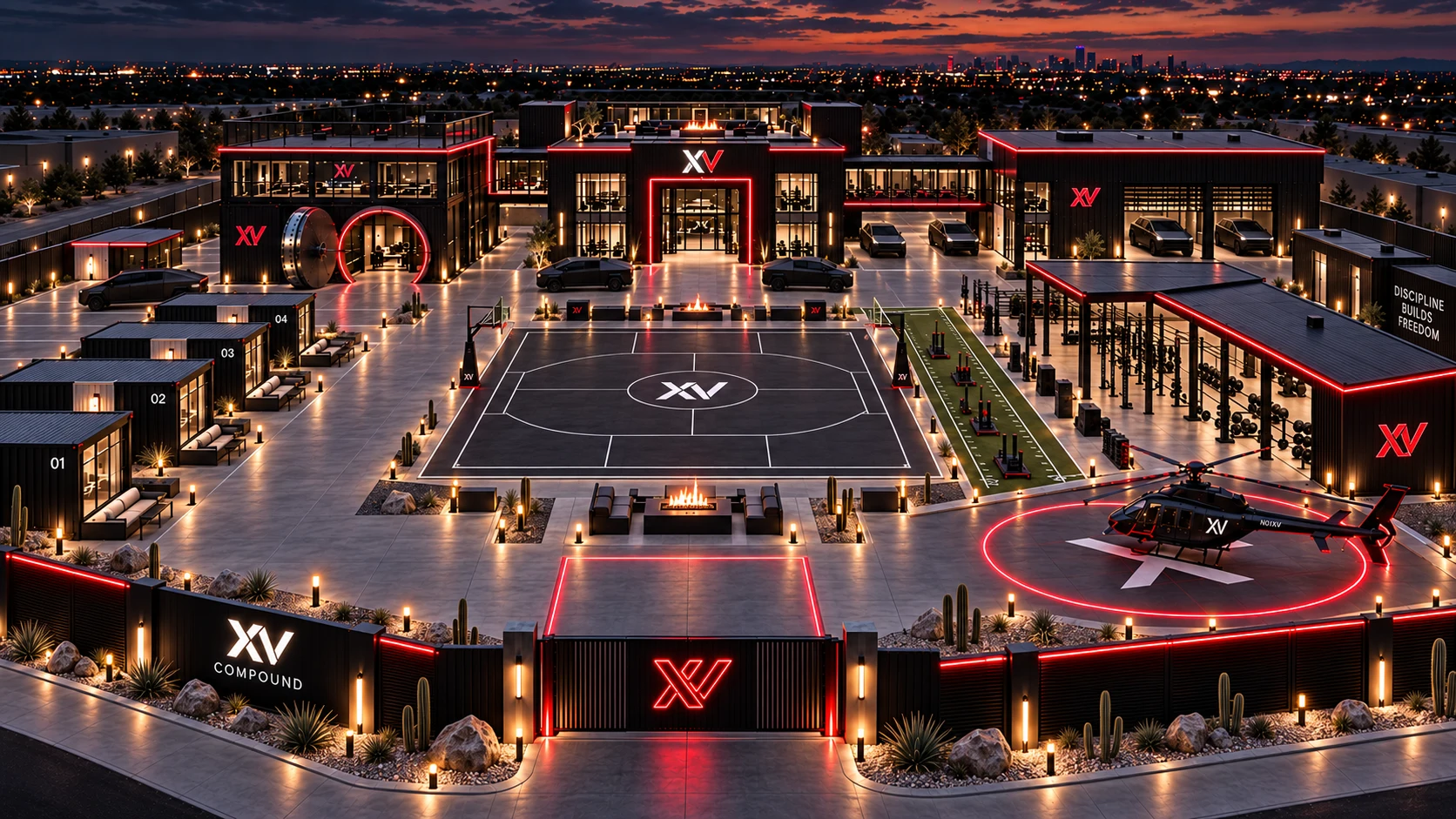
The XCLUSIV movement
THE XV PLAN.
EARN. PROVE. EXPAND.
The strongest path is not to build everything and hope memberships arrive. Start earning from the existing creative hub, prove the member economics, then expand into stays and retreats.
Illustrative underwriting · no actual accounts, bids or guaranteed returnsA sequence designed to reduce risk
MAKE THE NEXT STAGE
EARN THE RIGHT TO EXIST.
Select a stage. Facilities that do not exist in that stage cannot generate revenue in its calculation. All costs and booking assumptions are editable planning tests.
Earliest revenue: sell what the existing operation can actually deliver.
Package podcast recording, photo/creative time, approved private venue hire and paid strategy work. Validate demand through completed paid bookings. Do not sell the future member campus as if it is open.
Construction sensitivity, not a contractor quote
BUILD THE SCOPE.
FUND THE OPENING.
The founder’s $2m–$5m envelope remains the question to test. Land purchase, extraordinary site conditions, construction financing and the fleet are not included in these test budgets.
Separate from construction; do not spend the cash reserve on fit-out.
$100,000 assumed debt; $250,000 remaining equity cash.
| Cost component | Planning USD | How derived |
|---|---|---|
| Existing hub improvements | $200,000 | Editable refresh allowance; not a bid. |
| Build + opening cash | $350,000 | Not a commitment that all renderings fit this budget. |
The retreat-phase test may exceed $5 million before land and financing costs. That is a reason to phase or redesign—not remove contingency until the answer looks attractive.
Test the actual revenue streams
REVENUE IS NOT PROFIT.
SEE WHAT REMAINS.
Each line has direct delivery cost and payment fees. Salaried overhead excludes the same project labor already costed in the packages; reconcile actual staffing before financing.
Sales, not profit.
After direct costs, fees and fixed overhead; before financing and tax.
Before income tax and discretionary owner distributions.
Not an investor return or a prediction of the first year.
This case leaves $2,032 cash per month before tax. It requires the chosen booking volume, retention, provider economics and delivery capacity to hold.
| Monthly stream | Volume | Revenue | Direct cost | Fees | Contribution |
|---|---|---|---|---|---|
| Podcast studio hours | 96 | $14,400 | $5,280 | $432 | $8,688 |
| Photo / creative studio hours | 48 | $5,760 | $1,440 | $173 | $4,147 |
| Private venue bookings | 3 | $9,000 | $3,150 | $270 | $5,580 |
| Paid strategy / discovery projects | 2 | $10,000 | $5,500 | $300 | $4,200 |
| Total | $39,160 | $15,370 | $1,175 | $22,615 |
Contribution $22,615Fixed overhead −$18,000Debt payment −$1,584Replacement reserve −$1,000Cash before tax $2,032
The hub stage does not charge for future campus membership, rooms, clinic access or a fleet.
Exactly what the cost assumptions include
XV1 and XV2 reserve $1,000 and $1,000 per member for included-service delivery; XV3 reserves $1,200. XV2 production reserves $1,400, XV3 production $2,200, and XV3 brand/AI work $6,500 monthly per client. Additional member operations are $150 for XV1/XV2 and $200 for XV3. These are cost tests, not member wallets or promised counts.
Podcast direct labor/consumables are modeled at $55/hour; photo room at $30/hour; private venue fulfillment at 35% of price; strategy projects at 55%; mastermind delivery at 45%; retreat fulfillment at 50%; outside guest-home delivery at 35%. Fees apply to receipts. Package-delivery labor is not also included in the fixed-overhead line.
Fixed overhead is an editable allowance for management, non-project founders’ work, core staff, occupancy, insurance, property tax, utilities, maintenance, software and acquisition. It is not an approved staffing budget. Operator rent is assumed post-pilot; a waived-rent launch must set the receipt to zero. Operator minimum support is paid from the included-services budget, not added as a second revenue stream.
A retreat is four days and three nights in this test. It reserves all 6 homes for those nights; only the remaining 0.0 room-nights/month receive outside occupancy. Paid mastermind tickets here are separate dates from private retreats.
Demand sensitivity—not three promises
| Demand case | Members | Monthly revenue | Monthly operating EBITDA | Monthly cash after debt/reserve |
|---|---|---|---|---|
| 60% demand | 0 | $23,496 | -$4,431 | -$7,015 |
| Selected target | 0 | $39,160 | $4,615 | $2,032 |
| 120% demand | 0 | $46,992 | $9,138 | $6,555 |
Outside booking counts may be fractional as monthly averages. Overhead is held constant to isolate demand; growth can require extra staff, capacity and expense.
Do not oversell rooms.
144 planned studio room-hours/month against 384 theoretical hours, after member, operator and retreat use. Private venue demand uses 3.0 days before community and turnover time.
Cost the people.
0 production delivery hours and 0 brand/AI delivery hours/month imply approximately 0.0 and 0.0 delivery equivalents at a 120-hour productivity assumption. Founder demand: 0 of 48 allocated hours.
Keep speculative cash out.
Equity distributions, clinical referral payments, investment proceeds treated as sales, and Robotaxi revenue are all $0 in operating revenue. No profit depends on a future autonomous pickup.
The opening period must also survive
FUND THE RAMP.
NOT JUST THE BUILD.
This 24-month opening stress test starts booking demand at 40% and ramps it toward the selected level. Member stages begin at the editable opening-member count. Construction-period costs are not hidden inside this operating test.
After debt and replacement reserve, before tax.
Negative means more operating capital or different economics are required.
Excludes construction spending, taxes, changes in debt principal and investor distributions.
| Opening period | Ending members | Period cash | Ending cash balance |
|---|---|---|---|
| Quarter 1 | 0 | -$27,828 | $122,172 |
| Quarter 2 | 0 | -$17,651 | $104,521 |
| Quarter 3 | 0 | -$7,474 | $97,046 |
| Quarter 4 | 0 | $2,702 | $99,748 |
| Quarter 5 | 0 | $6,095 | $105,843 |
| Quarter 6 | 0 | $6,095 | $111,938 |
| Quarter 7 | 0 | $6,095 | $118,032 |
| Quarter 8 | 0 | $6,095 | $124,127 |
A proposed nonclinical launch model · not a signed operator offer
SUPPORT THE START.
BUILD AN INDEPENDENT BUSINESS.
A short, funded minimum can help a suitable operator open. Pay for real member services, credit those earnings against the minimum, and graduate away from support rather than creating a permanent subsidy.
The greater of the temporary minimum or earned reimbursement; not both added together.
Only the difference between eligible earned services and the pilot minimum.
Before the operator’s wages, materials, taxes, insurance or other business costs.
An allocation of existing membership dues, not additional revenue.
Across the selected number of initial nonclinical operators.
Not free profit: it remains part of the club’s overall service and operating budget.
The payment formula
Operator payout = max(pilot minimum, verified services × agreed tariff)In this example: max($1,500, 40 × $50) = $2,000. Then show any separately owed rent of $0 transparently.
Pilot month 1: rent is assumed waived and the minimum is in force.
At these settings, reserving every pilot minimum before any service earnings would require $18,000 over 3 months, plus delivery/support costs and the rest of the club’s operating reserve. This is not a wage guarantee, profit forecast or cash-on-hand claim.
Four operators before ten fully fitted suites.
Identify demand and viable service margins first. A $1,500 three-month floor and $1,000 later rent are proposed test terms, not promises. Some operators will need outside income, fewer committed hours, a larger justified reserve or a different structure.
20% and a path to independence.
Agree the strategic stake, what XV contributes, reporting rights, graduation milestones, ongoing marketing scope and a buyout process. Use an agreed independent valuation method rather than inventing a buyout multiple here.
Separate clinic structures.
This guarantee example is for eligible nonclinical businesses only. Clinic ownership, marketing, patient referrals and service-payment arrangements require specialist review. A fixed support price is not an automatic safe harbor.
Do not double-count this in The XV Plan. The per-member allocation and marketing support must be carved out of the existing service/staffing budget or separately reconciled—not counted as new dues or as the same expense twice. This panel does not automatically change the main model. Modeled post-pilot rent receipts are $0 per month and are not assumed to erase a service-budget shortfall.
Member referrals, graduation and legal review
A possible nonclinical club-acquisition incentive is a one-time $300 payment after an approved new member has remained paid and in good standing for 90 days. This is a proposal for legal review, excluded from the example above and funded from a separate acquisition budget—not perpetual sharing of dues or payment for patients. Do not launch it for clinical or regulated-provider referrals.
Graduation should test contribution margin, independent repeat customers, working capital and readiness for a lease. Equity can remain after graduation; future social/marketing work needs a sustainable service agreement. Buyout rights, timing and valuation belong in the legal documents.
The current Texas professional-entity ownership and patient-solicitation rules require separate review. Private-club branding does not waive them.
Texas professional-entity ownership requirementsTexas restrictions on patient solicitation and compensationEvidence, assumptions and next decisions
PROVE THE MARKET.
PRICE THE REAL SCOPE.
These nearby public offerings provide a sense-check—not a comparable-property valuation or a guaranteed rate. The model must be replaced with actual bids, provider schedules, contracts and bookings before money is committed.
Published podcast production and monthly packages; package scope changes the price.
Directional competitor context, not proof of XV demand or an XV price quote.A public one-hour studio-production booking listed at $125 when reviewed.
The $150 XV test requires its own equipment, operator and deliverable scope.2,831 sq ft; published 10-hour hire from $4,500 weekdays to $6,300 Friday/Saturday, with listed inclusions.
A local venue reference, not permission to use its occupancy or rate as an XV promise.Confirm registration, contract, security and pre-opening conditions before selling qualifying memberships.
No automatic exemption for a private or exclusive brand is assumed.Current documentation lists Model Y and Cybercab vehicles, not the proposed privately owned Cybertruck fleet.
Fleet concept remains visible; Robotaxi income stays at zero in base projections.The decision sequence
Confirm permitted uses and costs. Sell and fulfill paid pilots in the existing hub. Measure demand and true labor/service cost. Approve the membership menu and limited XV3 client capacity. Finance only a bid-supported core. Add guest homes and premium retreats once the calendar and cash support them.
XV3 is now modeled at a proposed $20,000/month, or $60,000 for the first 90 days. It is not a published live offer or guaranteed business outcome. Define included implementation, founder reviews and third-party costs before accepting a client.